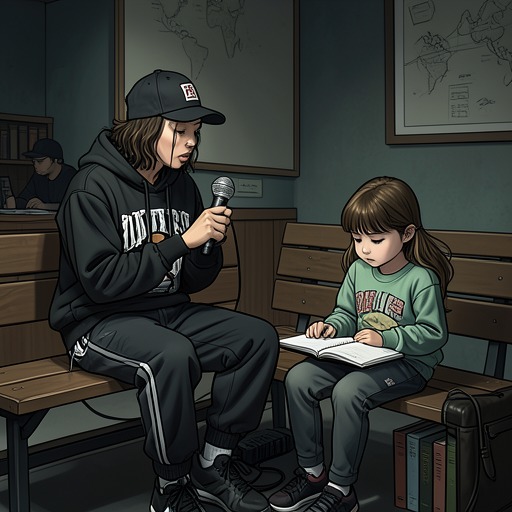
Brianna accepts Supreme’s management offer
On the Come UpBrianna’s acceptance of Supreme’s management offer is both a practical choice under financial pressure and a turning point in her struggle to control her identity as an artist. Supreme promises to provide for her family, and she takes his hand despite recognizing that the agreement betrays Aunt Pooh; the decision opens a professional path while setting up a conflict over who gets to define what Brianna performs and represents.
The Offer and Its Stakes
Supreme approaches Brianna while her song “On the Come Up” is drawing attention and has reached number one on Dat Cloud. He marks the achievement with a gift bag containing a dark-gray shoebox bearing a tree logo. Brianna recognizes the Timbs as more than a congratulatory present: together with Dee-Nice’s presence, they are part of Supreme’s effort to draw her away from Aunt Pooh and test whether she will accept his influence.
She is not mistaken about the personal cost. Brianna understands that Supreme’s offer could displace Aunt Pooh as her manager and that Pooh might remain involved in street life if that role disappears. She goes to the meeting anyway, aware that doing so will hurt her aunt. Her choice is driven in part by the family’s circumstances: she wants a way to help her mother, Jay, and her brother, Trey, and is willing to consider an arrangement she would otherwise resist.
Supreme argues that Brianna’s sudden publicity is an unusual opportunity that must be used quickly. He points to his work with Dee-Nice and mentions a major deal in development for his son, provided that his son can stay focused. Dee-Nice describes how he had been battling at The Ring while his family struggled; Supreme devised a plan that enabled him to support them. His account supplies Brianna with a concrete example of what management might offer, rather than only a promise of fame.
The Decision
Brianna asks Supreme directly whether he can make sure her family will be okay if she works with him. He promises that both she and her family will be provided for, then offers his hand. Brianna shakes it. She frames the decision as a betrayal of Aunt Pooh but also as a possible means of helping Jay and Trey, making the handshake a choice between competing forms of family loyalty rather than an uncomplicated career move.
Supreme celebrates the agreement and says that he will first need to speak with Jay so the three of them can sit down together. Brianna’s immediate hesitation exposes a gap between the agreement she has just made and the family’s consent: she expects Jay to reject the arrangement. She tells Supreme that she will talk to her mother first, but the narration makes clear that this is a lie intended to postpone the conversation. Supreme accepts the delay and returns to the prospect of making money; the scene ends with the management relationship agreed in principle, but not yet openly negotiated with Jay.
The Business Logic of Performance
Supreme’s offer is connected to an earlier lesson about public image. After a confrontation in a parking lot attracts attention, he warns Brianna that people will shape the story around her and advises her to play whatever role they expect, using their assumptions to her advantage. He describes appearing before executives in tailored suits and designer shoes while still being read as a hood figure, and presents that mismatch as something he knows how to exploit for financial gain. The advice treats identity partly as a performance managed for an audience, not simply as a private truth.
That strategy has a troubling precedent in Brianna’s own family. Later, when she resists recording a song written by Dee-Nice, Supreme insists that music is a business and urges her to take the opportunity for money. He offers to make the song’s street image look convincing, then reveals that he once encouraged Law to rap about street life and associate with the GDs to appear authentic. Law, Supreme says, took the role seriously. He urges Brianna to remember the difference between playing a role and becoming it, while acknowledging that he and Law did not get to do everything they might have done together. Brianna understands that Supreme sees her as a chance to redo what happened with her father. The later confrontation gives the earlier handshake its full weight: accepting Supreme’s help also places her within a model of success that once shaped Law’s public identity.
Public Image and Artistic Conflict
Brianna’s rise is already being interpreted by others before she accepts the offer. A news report identifies “On the Come Up” as her song, calls it violent, and says it is popular among young listeners; the coverage presents fragments rather than the full track. During a later radio interview, Hype links the song to a school riot and challenges Brianna over lyrics about weapons and police. Brianna objects that the reporting has ignored why students protested, and points out the gendered double standard in the scrutiny: Hype says he was not similarly surprised when her father rapped about such subjects as a teenager, but reacts differently to a sixteen-year-old girl doing so.
The same pressure appears in the studio, where James praises Brianna with a racialized stereotype. She objects, and Supreme takes her into the hall. There he argues that she must record Dee-Nice’s song because the business opportunity is valuable, even offering to provide people who would make its image seem more authentic. Brianna refuses to treat commercial success as a reason to perform material that does not feel like hers. The conflict is not simply between independence and help: Supreme’s promise of family security remains real, but his strategy asks her to risk the authenticity and authorship she regards as essential.
Reclaiming the Role
At The Ring, Brianna ultimately refuses to perform words that are not her own. In her freestyle, she rejects being treated as a joke, a pet, a puppet, or a clone, and insists that her identity includes being a daughter, sister, source of hope, and reflection for others. She distinguishes describing what she sees from claiming that she personally embodies every image in her lyrics, and challenges the way outsiders turn those images into proof of a presumed identity. The performance answers the tension at the heart of Supreme’s offer: she can pursue opportunity without surrendering authorship of her own voice.
The acceptance therefore does not settle Brianna’s artistic direction. It establishes the pressure under which that direction will be contested: her family needs support, Supreme has demonstrated that he can build a career, and his methods carry a history of turning street stereotypes into marketable roles. Brianna’s later refusal of the ghostwritten song and her own Ring performance mark a boundary the original handshake could not guarantee. The decisive question becomes not whether she will enter the music business, but whether she can use its opportunities without becoming the role other people have prepared for her.